Creating an Experience Orchestration System
Building the framework that keeps a complex customer journey coherent across teams.
Role
UX Director
Timeline
2025–2026
Outcome
A shared decision-making layer that reduces experience debt and aligns upstream and downstream teams.
The problem
Product, marketing, growth, member success, and engineering were each responsible for pieces of the customer experience—but no one was responsible for how those pieces worked together. Teams could make the right decision for their function and still create the wrong experience for the customer. The challenge wasn't another process. It was creating shared ownership of the journey without taking ownership away from the teams delivering it.
Customers don't experience departments. They experience one continuous journey.
Creating an orchestration layer
I developed an Experience Orchestration model to create a connective layer between business strategy and the experience customers actually receive. Rather than centralizing every decision, orchestration establishes shared experience intent, protects critical transitions, creates decision guardrails, and connects success measures across the journey.
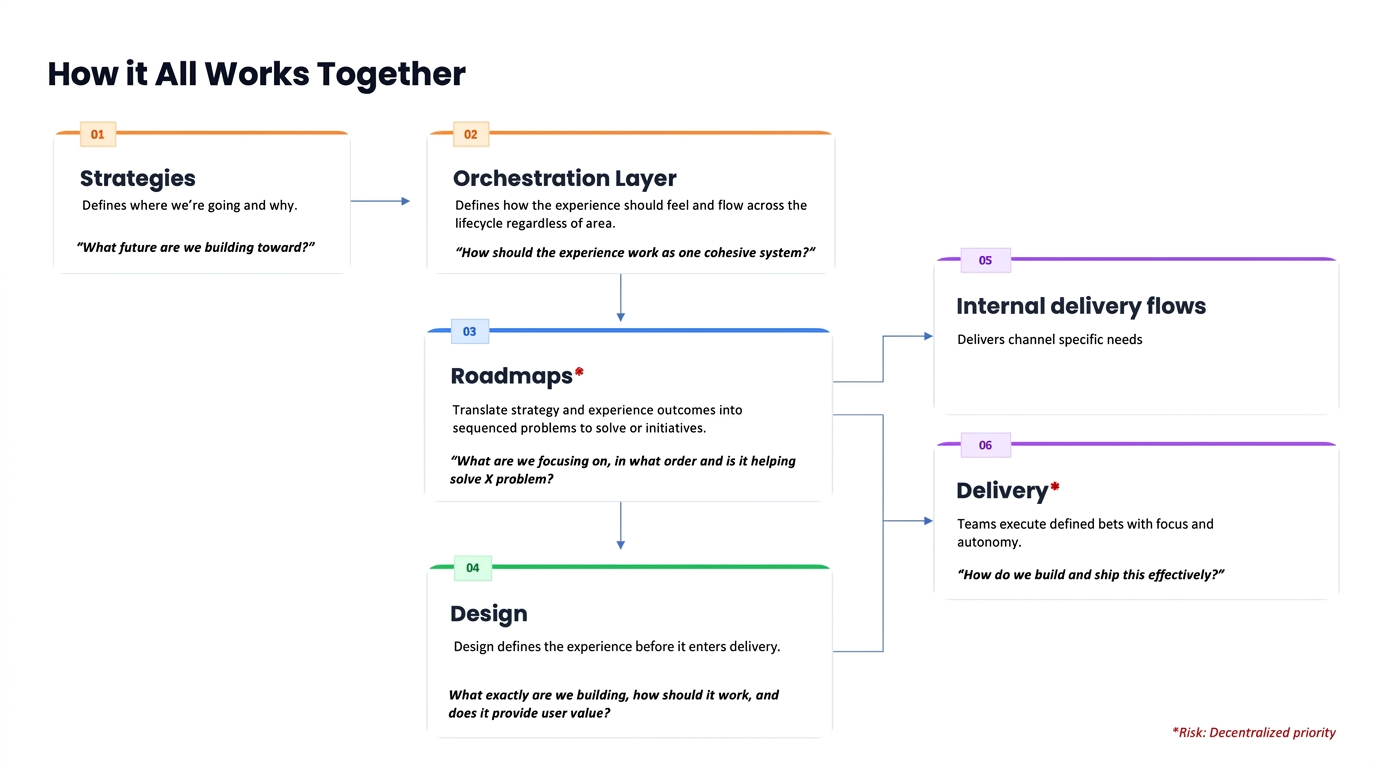
Strategy defines where we're going. Orchestration protects the experience getting there. Teams own how it's delivered.
One lifecycle, shared across the organization
We established a common lifecycle spanning Discover → Explore → Commit → Begin → Establish → Grow → Transition. But this wasn't simply another journey map. For each phase, we defined the experience intent, human needs, critical moments, shared outcomes, signal categories, and touchpoints.
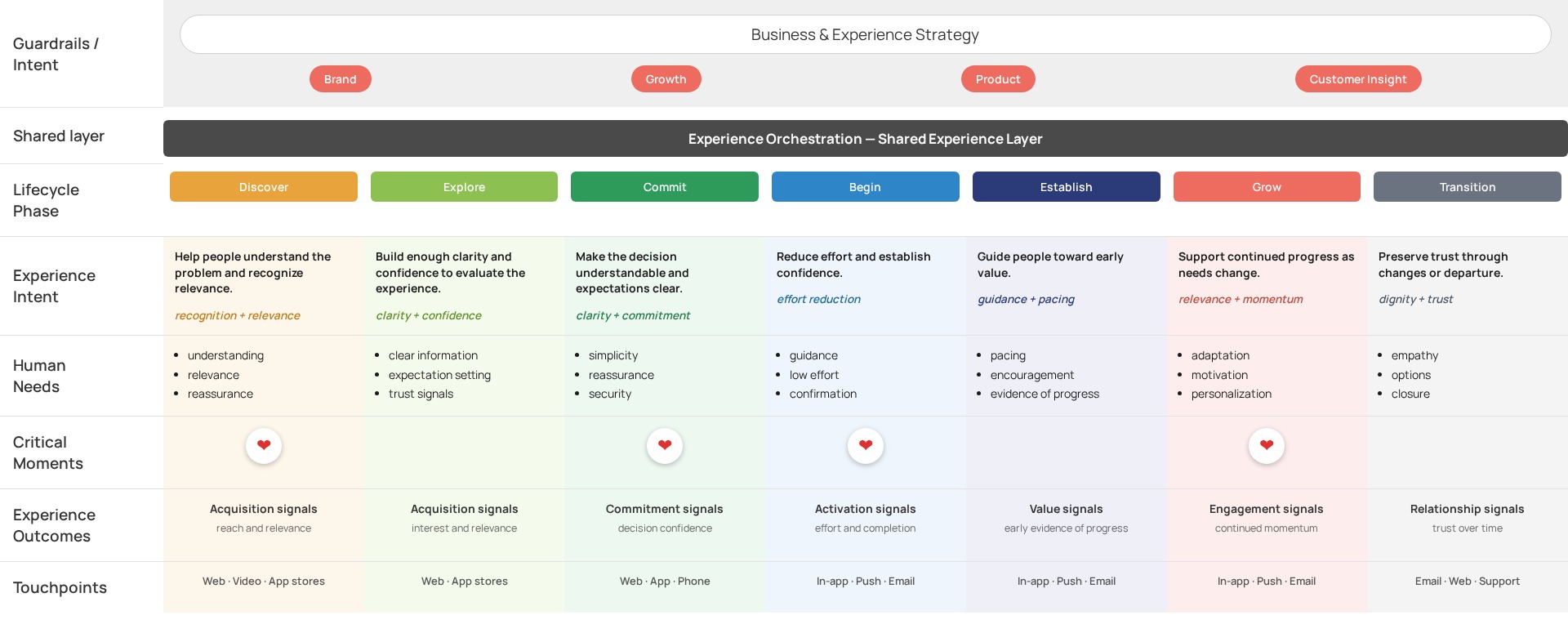
The lifecycle shifted the conversation from “Who owns this touchpoint?” to “What does the customer need at this moment?”
What the orchestration layer owns
Experience Orchestration wasn't designed to own every customer decision. It focuses on the places where continuity across the journey can break.
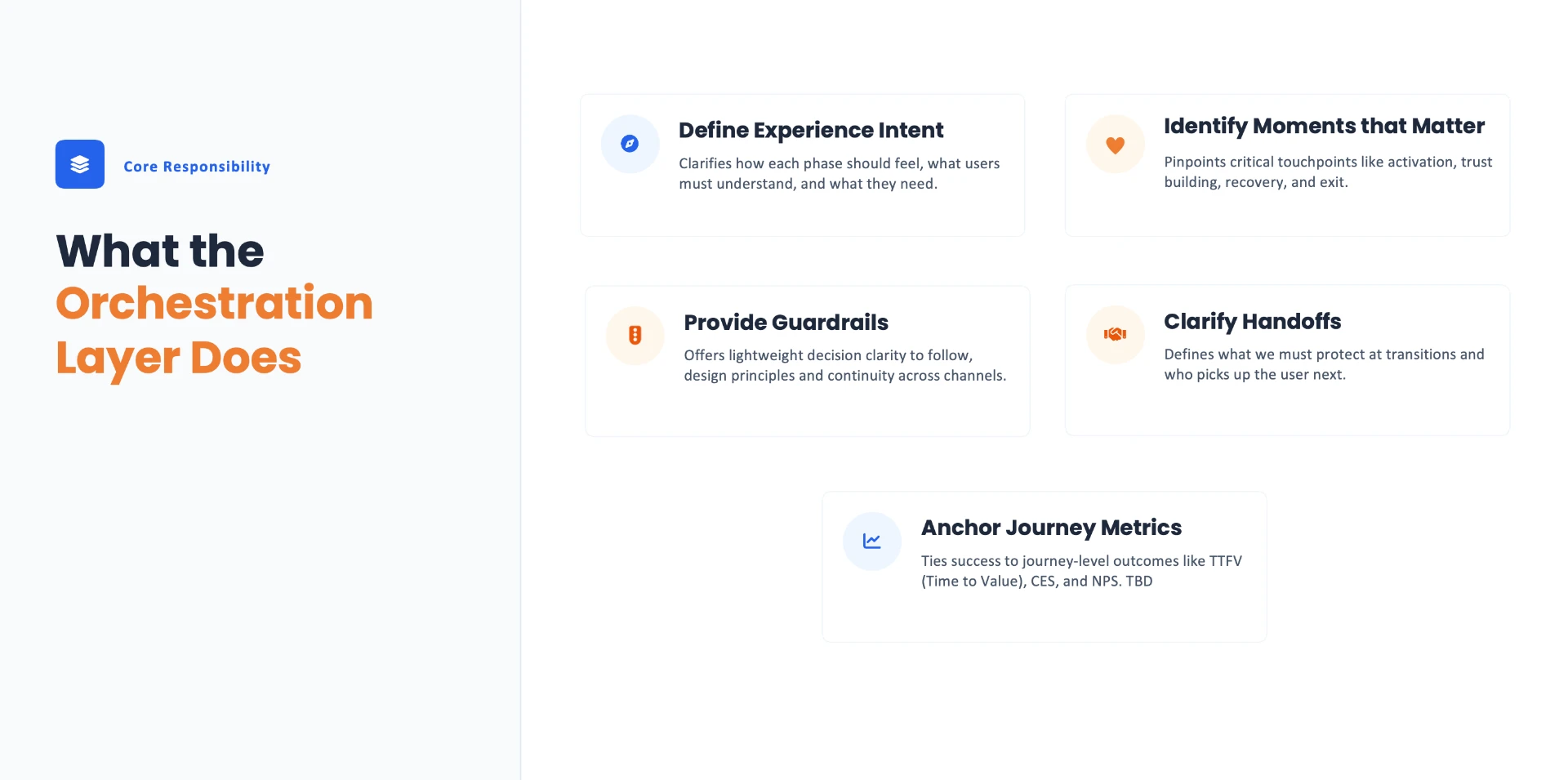
Together, these create enough structure to maintain coherence while allowing individual teams to retain ownership of execution.
Protecting the moments that matter
Not every interaction deserves the same level of organizational attention. We identified moments where the experience carries disproportionate emotional or behavioral weight—from recognizing that the service understands you, to making a vulnerable commitment, seeing the first evidence of progress, or returning after a setback.
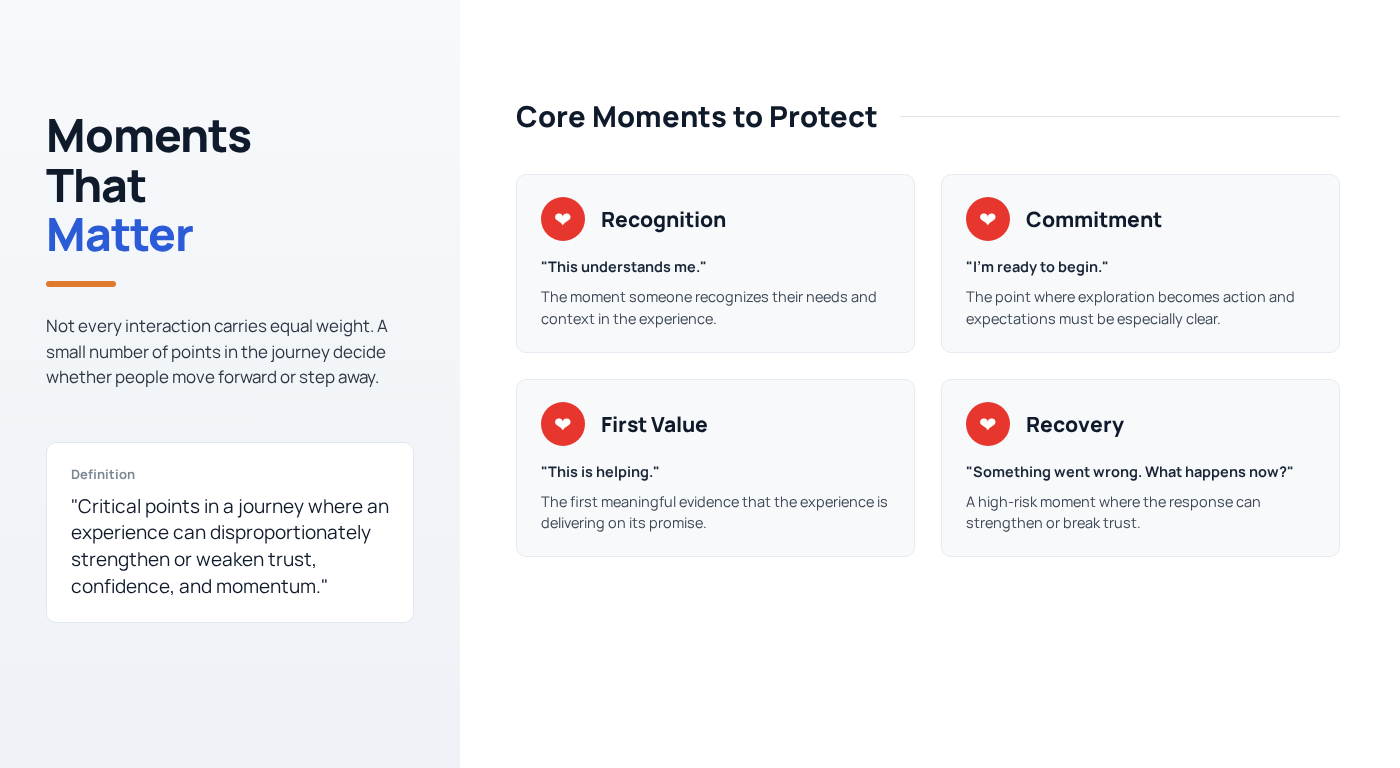
These became moments to deliberately protect across teams and touchpoints, focusing organizational attention where experience quality has the greatest potential to build—or break—trust, confidence, and momentum.
From principles to everyday decisions
A shared journey isn't enough. Teams also need a consistent way to make decisions within it. So I built a decision architecture that carries belief all the way down to execution: Core Beliefs → Experience Principles → Decision Principles → Experience Standards → Patterns. Beliefs establish what we hold true about the people we serve. Principles turn those beliefs into how experiences should behave and how teams make tradeoffs. Standards define what good looks like in execution, organized by lifecycle area. Patterns are how those standards actually show up in the product. Enough structure to create coherence. Enough autonomy to keep teams moving.
The decision model answers a harder question: how do you keep an end-to-end experience coherent when no single department owns the whole journey? Three questions—intent, continuity, and evidence—determine whether a change stays a local decision or needs a shared, cross-functional one. Three principles resolve the conflicts: lifecycle over local optimization, continuity is shared, and evidence over opinion.
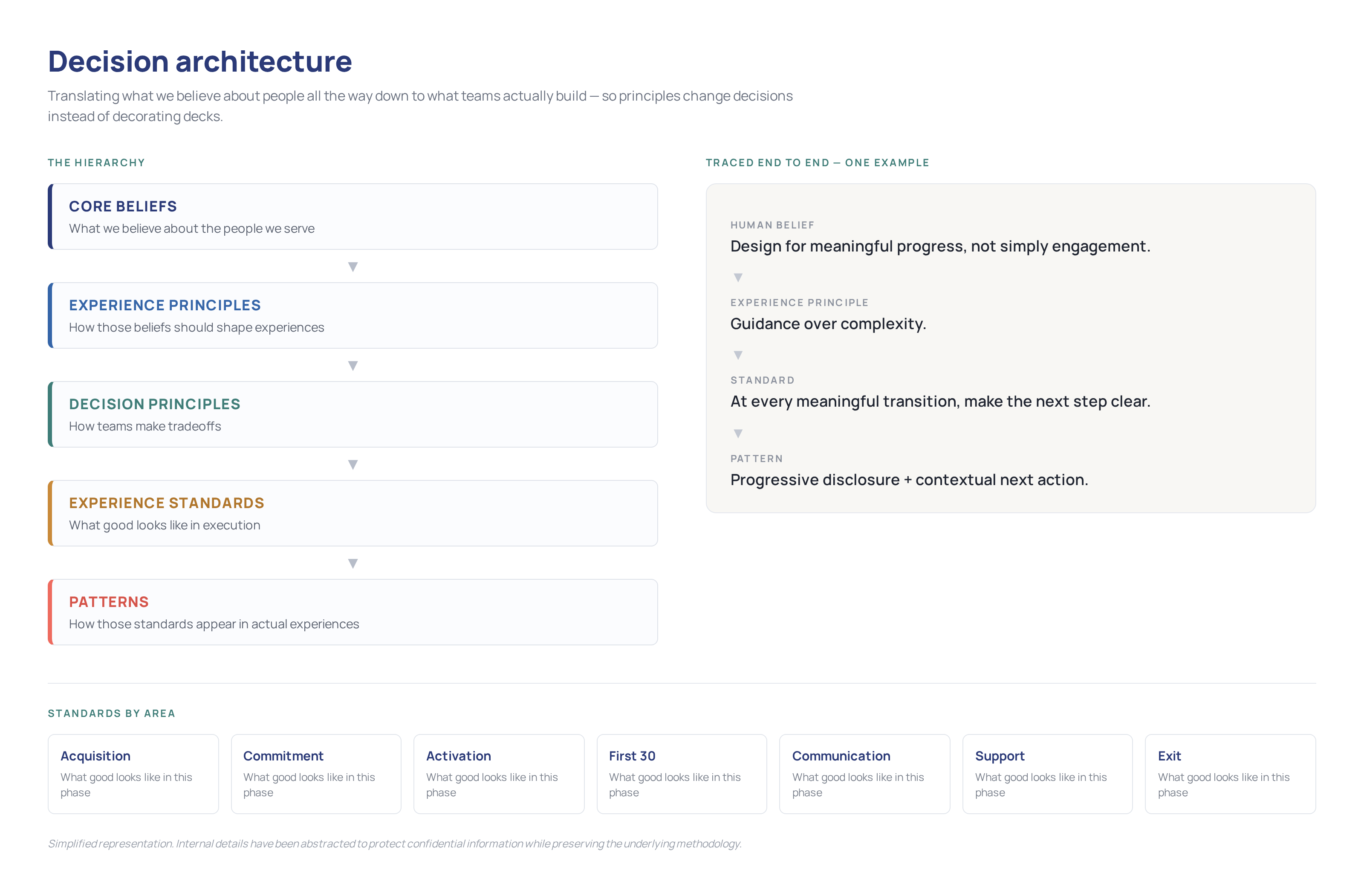
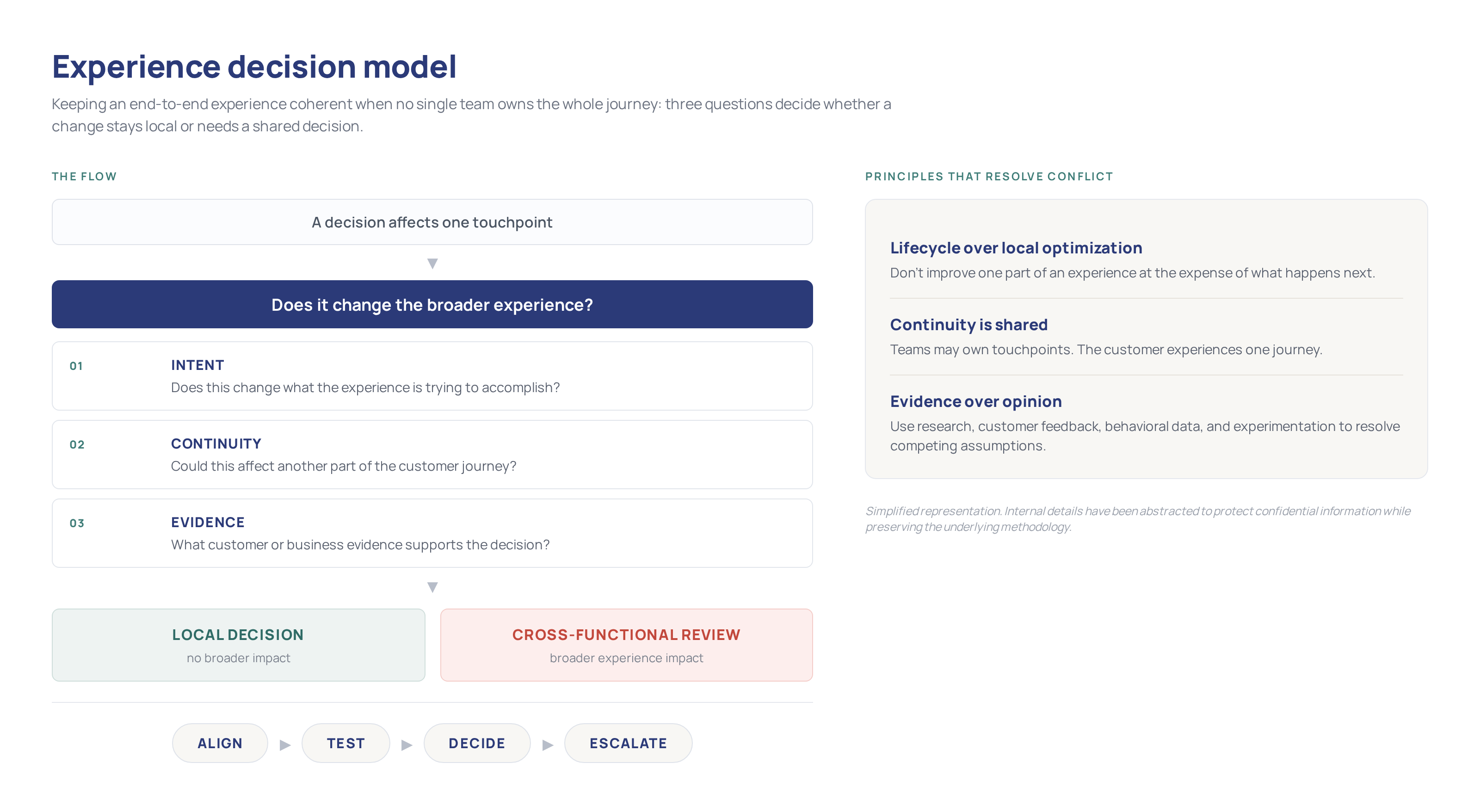
The goal isn't design control. It's protecting continuity where one team's decision can change someone else's experience.
Why it matters
Experience fragmentation is often an organizational problem disguised as a design problem. Customers don't experience product strategy, marketing strategy, support strategy, and engineering delivery separately. They experience one continuous relationship with the company. Experience Orchestration created a way to manage that relationship intentionally—connecting strategy, teams, decisions, and measures around one shared journey without creating another centralized gatekeeper.
Teams optimizing touchpoints
Teams contributing to one experience
Functional metrics
Shared journey outcomes
Design-by-debate
Principles + evidence
Ambiguous ownership
Shared stewardship
Next use case
Building a Design Organization That Scales